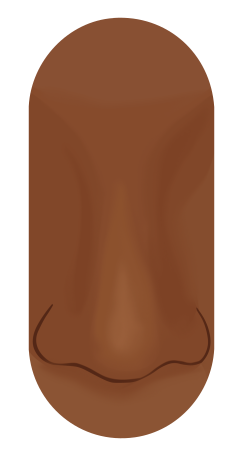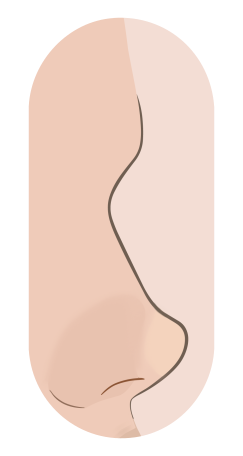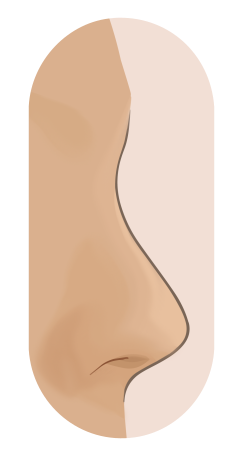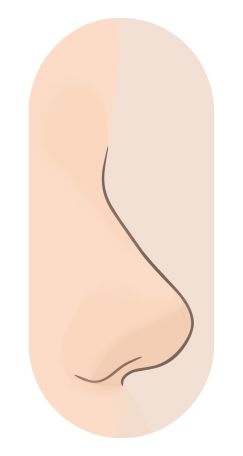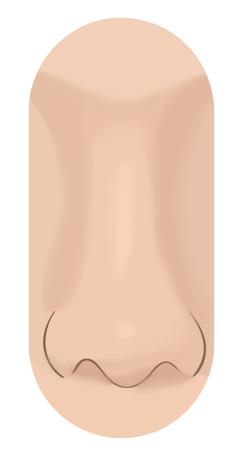
Nose ShapesPROFILE ANALYSIS

Types of noses

There are two ways to sort noses. One names the profile, the line you see from the side. The other measures the width against the height. This page covers both, then shows you how to find out which types you have. If you would rather skip the reading, analyse your nose shape from one photo.

Two ways to sort nose types

By profile. Sculptors and artists gave us names like Greek, Roman and Button. They describe whether the bridge is straight, curved or scooped and where the tip points. You need a side view to tell them apart.

By width. Anthropologists divide noses into four bands using the nasal index. It is the width of the nose divided by its height, times 100. You can read it from a front photo, so it is the one our analyser reports.

Every nose has both. A Roman nose can be narrow or broad, and a broad nose can be straight or ridged.

The twelve profile types of noses

These are the names people use most. They are field-guide labels, not medical categories, and most real noses sit between two of them.

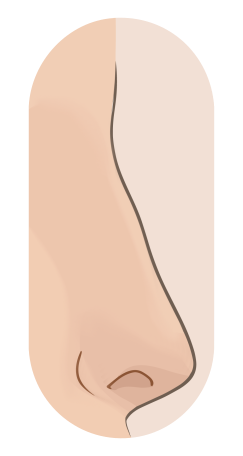
Profile drawing of a Greek nose: one straight line from brow to tip 01

Greek

A straight bridge with no dip and no hump, running in one line from brow to tip. It is the profile classical sculptors kept carving, so it became the textbook default. Real noses that match it closely are less common than the statues suggest.
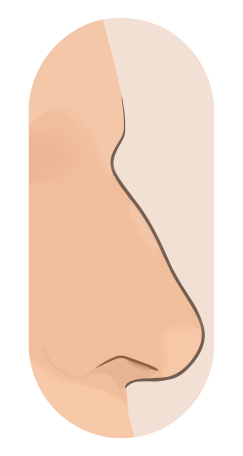
Profile drawing of a Roman nose: a convex curve along the bridge 02

Roman

Also called aquiline. The bridge curves outward and the tip points slightly down. You only see the curve from the side, which is why it shows up on coins and busts far more than in passport photos.

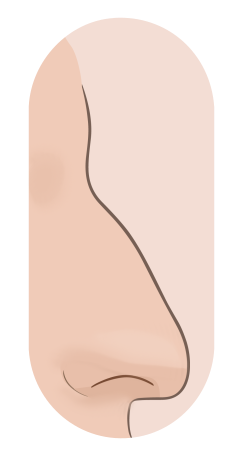
Profile drawing of a hawk nose: a pronounced hook with a sharp tip 03

Hawk

A stronger Roman curve. The bridge hooks clearly and the tip ends pointed instead of rounded. If your bridge bulges and your tip hangs below the nostrils, this is the closer name.

Profile drawing of a Nubian nose: a long bridge widening to a broad base 04

Nubian

A long bridge that widens as it drops and ends on a broad base, with nostrils that flare to the sides. On the nasal index scale it usually falls in the broad or very broad bands.

Profile drawing of a snub nose: short and narrow with a lifted tip 05

Snub

Short and narrow, with the tip lifting away from the lip. People tend to notice the angle before the size. Often used as the opposite of the hawk nose.

Profile drawing of a celestial nose: a scooped bridge that turns up at the tip 06

Celestial

Close to the snub, but with a visible scoop partway down the bridge before it turns up. The dip is what separates the two. Also called a turned-up nose.

Profile drawing of a button nose: small and neat with a compact tip 07

Button

Small and neat all round: a soft slope, a compact tip and little projection from the face. The name comes from the tip, which looks like a button.

Profile drawing of a bulbous nose: a rounded tip wider than the bridge 08

Bulbous

A rounded, fuller tip that reads wider than the bridge above it. The weight of the nose sits in the bottom third. Tip width is one of the four things our analyser measures.

Profile drawing of a fleshy nose: soft tissue over the whole nose 09

Fleshy

Softer tissue across the whole nose, so neither the bridge nor the tip looks sharply defined. A very common shape, and the name says nothing about weight.

Profile drawing of a flat nose: low projection with a broad bridge 10

Flat

Low projection from the face, with a broad bridge that sits close to the line between the eyes. It is a description of height, not a judgement.

Profile drawing of a bumpy nose: a ridge partway down the bridge 11

Bumpy

A ridge or dip partway down the bridge instead of one clean line. Often the result of an old break that healed slightly off, but plenty of people are born with it.

Profile drawing of an East Asian nose: a lower bridge with a rounder tip 12

East Asian

A lower bridge with a rounder tip and a narrower nostril base. Like every name here it describes a shape, not a person, and plenty of people anywhere have it.

The four nose widths: narrow to very broad

The nasal index bands come from Paul Topinard, who published them in the 1880s. Anthropologists still use them.

  • Under 70, narrow (leptorrhine). The nose is clearly taller than it is wide.
  • 70 to 85, medium (mesorrhine). Height and width are fairly balanced.
  • 85 to 100, broad (platyrrhine). The nose is almost as wide as it is tall.
  • Over 100, very broad (hyperplatyrrhine). The nose is wider than it is tall.

How to tell which type of nose you have

  1. Stand in even light and take a photo straight on, at eye level, with a neutral face.
  2. Measure the height from the point between your eyebrows to the base of the nose, where it meets the lip.
  3. Measure the width at the widest part of the nostril wings.
  4. Divide the width by the height and multiply by 100. Compare the result with the four bands above.
  5. Take a second photo from the side against a plain wall. Look at the bridge: straight, curved, scooped or ridged. Match it to the list above.

Step 4 is easy to get wrong by a few points when you measure by hand. The free nose shape analyser places 468 landmarks on your face and does the sum for you. In our own test, two photos of the same person landed within half a percent of each other.

Do nose types differ by sex or ethnicity?

The profile names are not tied to sex. Smaller noses get called Button or Snub and larger ones Roman or Hawk, but every group has all of them.

Width does vary by region. In 1923 Thomson and Buxton found that nasal index tracked climate, and a 2017 study in PLOS Genetics (Zaidi and colleagues) linked nostril width to temperature and humidity. Wider noses are more common in warm, humid regions and narrower ones in cold, dry ones. The groups overlap a lot, so a single nose tells you very little about a person.

Questions about nose types

How many types of noses are there?

There is no official number. The names people use most are the twelve profile shapes on this page: Greek, Roman, Hawk, Nubian, Snub, Celestial, Button, Bulbous, Fleshy, Flat, Bumpy and East Asian. Anthropologists instead sort noses into four bands by width, called the nasal index.

What are the different nose shapes?

Most names describe the profile, the line you see from the side: straight, curved, hooked, scooped or flat. A second set of words describes the front view: narrow, medium, broad and very broad. A real nose combines one of each.

What is the most common type of nose?

There is no reliable count, because it varies by region and by how the shapes are defined. Most people have a soft, rounded tip and a bridge that is not perfectly straight, so the clean textbook shapes are the exception.

What type of nose do I have?

Check two things. From the front, work out your nasal index with the steps above or with the free analyser on our home page. From the side, take a photo against a plain wall and look at the bridge: straight, curved, scooped or ridged.

Are there types of noses for females and males?

The names are not gendered. Button, Snub and Celestial are often used for smaller noses and Roman and Hawk for larger ones, but both appear in every group. Average nose size differs a little between sexes, the shapes do not.

Do nose types depend on ethnicity?

Partly. Average nasal width differs between regions, and researchers link wider noses to warm, humid climates and narrower ones to cold, dry ones. The overlap between groups is large, so a nose says little about where a person is from.

Can a nose type be changed?

Surgery can change the profile and the tip. Without it, the bone and cartilage stop changing after growth. Soft tissue shifts a little with age, so a nose can look heavier or droopier later in life.

Find out what yours is called

One photo, four measurements, an answer at the end of it.

Analyse my nose