 01
01
Greek
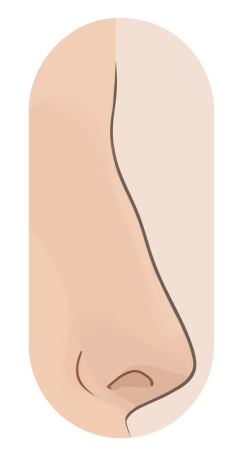
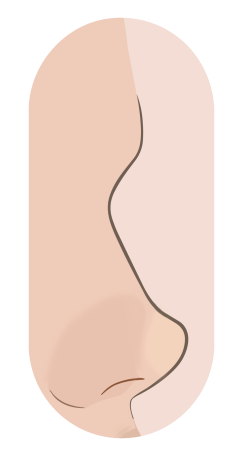
One straight line from brow to tip, with no dip and no hump. The profile classical sculptors kept carving, which is where the name comes from.
Upload one photo. The analyser measures your nose against the nasal index, the width to height ratio anthropologists have used since the 1880s, and tells you which band you land in.
Upload a photo
Your photo is held only until your result loads, then it is deleted. How we handle data
Nose shapes were named by sculptors and anatomists long before anyone put a camera on them. This is the set most people mean when they talk about nose types. Almost all of them are defined by the profile, the line you only see from the side, so a front-facing photo cannot tell them apart. The analyser measures width and height instead. Read these as a field guide, not as your result.
01
One straight line from brow to tip, with no dip and no hump. The profile classical sculptors kept carving, which is where the name comes from.
 02
02
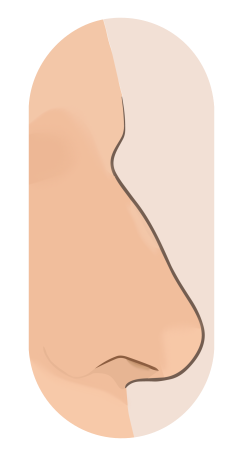
Also called aquiline. A convex curve runs down the bridge and the tip points slightly down. It reads strongest from the side, which is why portrait busts love it.
 03
03
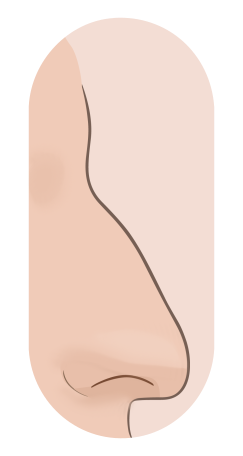
A sharper version of the Roman curve. The bridge hooks noticeably and the tip finishes pointed rather than rounded.
 04
04
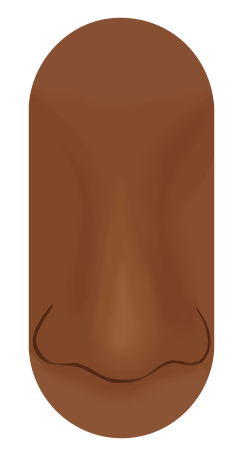
A long bridge that widens as it drops, finishing on a broad base with nostrils that flare out to the sides.
 05
05
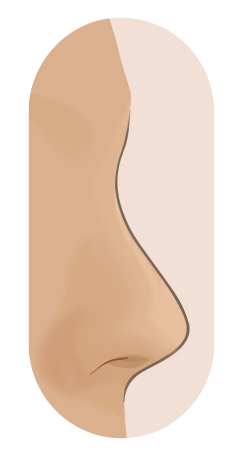
Short and narrow, with the tip lifting away from the lip. Small enough that people usually notice the angle before the size.
 06
06
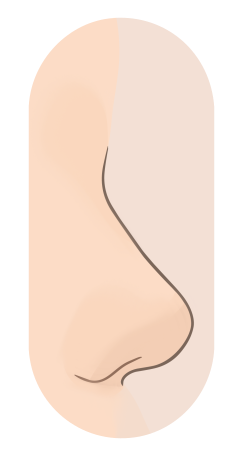
Close to the snub, but with a visible scoop partway down the bridge before it turns up. The dip is what tells the two apart.
 07
07
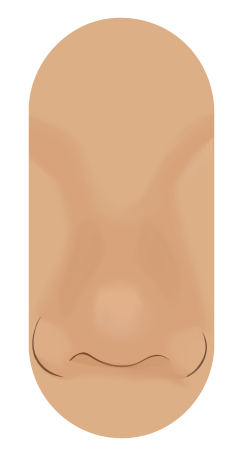
Small and neat all round. A soft slope, a compact tip and very little projection from the face.
 08
08
A rounded, fuller tip that reads wider than the bridge above it. The weight of the nose sits in the bottom third.
 09
09
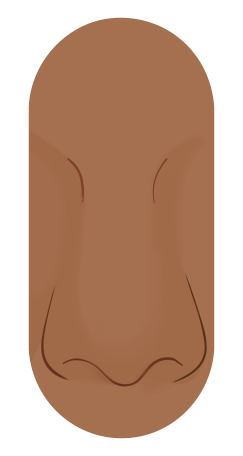
Softer tissue across the whole nose, so neither the bridge nor the tip reads sharply defined. One of the most common shapes there is.
 10
10
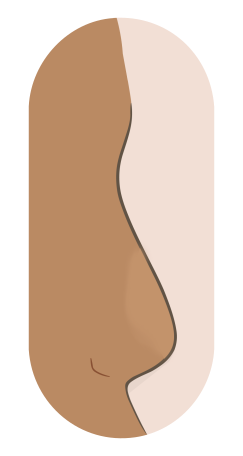
Low projection from the face, with a broad bridge sitting close to the line between the eyes.
 11
11
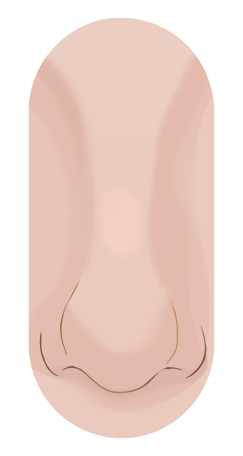
A ridge or a dip partway down the bridge rather than one clean line. Often the result of an old break that healed slightly off.
 12
12
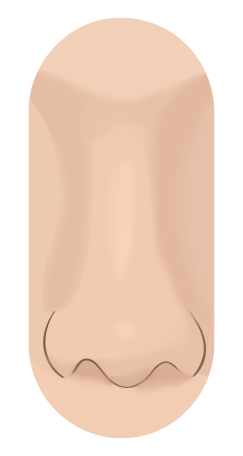
A lower bridge with a rounder tip and a narrower nostril base. Like every name on this page it describes a shape, not a person.
A landmark model drops 468 points on your face. From those the analyser takes four ratios, all of them widths and heights, because those are the only things a front-facing photo gives you reliably. The first one decides your result. The other three describe it.
The width of your nose at its widest divided by its height from the root to the base, times a hundred. Paul Topinard published these bands in the 1880s and anthropologists still use them.
How wide the dorsum runs at mid-bridge, measured against the width of your nose at its widest.
The width of the tip lobule against the wings below it. A fuller tip reads wider relative to the base.
How far the wings spread out beyond the nostril base.
Depth is missing from all of this on purpose. Whether a bridge is straight or curved, and whether a tip turns up or down, are things you can only see from the side. A landmark model reading a front photo has to guess at them, so we do not ask it to.
The photo is shrunk in your browser before it is sent, held on our server just long enough to run the measurements, and deleted the moment your result appears on screen. There is no account, no gallery, no export.
Nothing is used to train a model and nothing is passed to an advertiser. The only thing that leaves the page afterwards is the name of the shape, with no photo and no identifier attached, so we can see which shapes turn up most often. Read the full policy
Knowing the name is fun on its own, but it also settles a few practical questions.
Nearly every contouring tutorial assumes a nose shape without saying which one. Knowing yours tells you whether to shade the sides, the tip, or nothing at all.
Glasses sit on the bridge, so bridge width and height decide whether a frame slides down all day. A wide bridge wants a keyhole, a low one wants adjustable pads.
Most people have never had a word for the middle of their own face. Having one turns a thing you might have been self conscious about into a category with a long history.
Upload a front facing photo at the top of this page. The analyser places 468 landmarks on your face and works out your nasal index: the width of your nose divided by its height. That puts you in one of four bands, narrow through very broad. It takes a few seconds and needs no account.
The names most people use are Greek, Roman, Hawk, Nubian, Snub, Celestial, Button, Bulbous, Fleshy, Flat, Bumpy and East Asian. They are not scientific categories, and most of them describe the profile rather than the front view.
The classification that is scientific is the nasal index, which splits noses by width against height into narrow, medium, broad and very broad. That is the one this tool measures, because it is the one a front-facing photo supports.
Because a Roman nose is a profile shape. The convex curve along the bridge and the slightly downward tip only exist as a silhouette, which is why the shape shows up on coins and portrait busts and not in passport photos. From the front, a Roman nose and a straight Greek one can measure identically.
To see yours, take a photo from the side against a plain wall and look at the line from brow to tip. If it bulges outward, that is the Roman curve.
For width, yes. We measured the same person in two unrelated photos at different resolutions and the nasal index came out 89.45 and 89.86, a difference of under half a percent. The bands are the published anthropometric ones rather than numbers we picked.
What it cannot do is read your profile. Whether your bridge is straight or curved, and whether your tip turns up or down, are only visible from the side. A model looking at a front photo has to guess, so we do not ask it to and we do not report it.
No. The photo is held only long enough to run the measurements and show you the result, then the record is deleted. Nothing is used for training and nothing is sent to a third party.
The landmark model needs to see a whole face pointed roughly at the camera. Strong side profiles, heavy shadow across the nose, sunglasses, masks and very low resolution photos are the usual reasons it comes back empty. A plain selfie in daylight works best.
The bone and cartilage stop changing once you finish growing. The soft tissue around them keeps changing, so a nose can look slightly heavier or droopier with age even though the underlying structure is the same. Weight changes and a broken nose can both move the result too.
Yes, in the same loose way that height or hair texture varies by region. Broader bases are more common closer to the equator and narrower ones further from it, which is usually explained as an adaptation to humidity. The variation inside any group is far larger than the difference between groups, so a name tells you about a shape and nothing else.
There is no answer that survives crossing a border or a decade. The straight Greek profile has been the western default since antiquity mostly because that is what got carved, and surveys in other regions put the emphasis elsewhere entirely. Every shape on this page belongs to a lot of faces people find striking.
One photo, four measurements, an answer at the end of it.
Analyse my nose