East Asian nose
The East Asian nose shape has a lower bridge, a rounder tip and a fairly compact nostril base. The name describes a common shape, not a person: people of every background have it, and many East Asians do not.
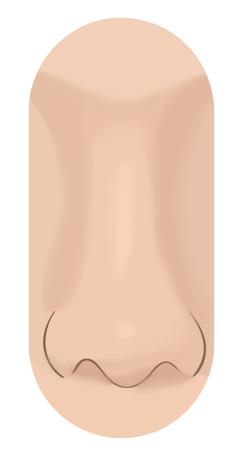
| Root | Low |
|---|---|
| Bridge | Fairly flat and straight |
| Tip | Rounded, often thicker skin |
| Nostrils | Oval, open slightly to the sides |
| Usual width | Often medium, wide range |
| Closest neighbours | Flat (low throughout), Button (small overall) |
Features of the East Asian nose shape
- A low root between the eyes, so the nose starts low on the face.
- A bridge that stays fairly flat and straight.
- A rounded tip, often with thicker skin.
- Nostrils that are oval and open slightly to the sides.
The shape lies on a range. Plenty of people in China, Japan and Korea have high, narrow bridges, and plenty of Europeans have low ones.
How it differs from a flat nose
The two overlap. Flat describes low projection along the whole nose. The East Asian label adds a rounded tip and a compact base. A nose can be both.
The width of your nose is the part a front photo can measure. Our nose shape analyser gives you that in seconds; the profile is for your side photo.
What the research says about width
On the nasal index, East Asian noses often fall in the medium band, 70 to 85, though the range is wide. The index divides the width by the height, so a short nose with average width reads wider.
Width follows climate across populations. Studies from Thomson and Buxton in 1923 to Zaidi and colleagues in 2017 found narrower noses in colder, drier regions. Within any population the differences are larger than between them.
Glasses that fit a low bridge
A low root means standard frames slide down and the lenses touch the cheeks. Eyewear brands sell low bridge fit or Asian fit versions with taller nose pads that lift the frame.
Any frame with adjustable metal pads can be fitted by an optician. With acetate frames, check that the pads are built up, not flush with the frame.
Beauty trends and surgery
A higher bridge is a popular cosmetic goal in parts of East Asia. Augmentation rhinoplasty, which raises the bridge with cartilage or an implant, is one of the most common procedures there.
Tastes differ and change. Many people prefer their natural profile. A lower bridge is not a problem to fix.
Questions about the east asian nose
Why are some East Asian noses flatter?
Bridge height is inherited and varies by population, likely shaped by climate and chance over many generations. It is normal variation, not a defect.
Can the analyser tell my ethnicity from my nose?
No, and it does not try. It measures four width ratios and reports your nasal index band. A nose says little about where a person is from.
Is the East Asian nose the same as a button nose?
They share a rounded tip. A button nose is small overall. The East Asian label centres on a low bridge and a compact base.
Related nose types
Flat nose
A flat nose has a low bridge and little projection from the face. Learn the signs, how it …
ReadButton nose
A button nose is small with a soft slope and a round, compact tip. Learn the signs, how …
ReadMedium nose width
A medium nose has a nasal index of 70 to 85, with width and height in balance. Learn …
ReadAll twelve profiles: Greek, Roman, Hawk, Nubian, Snub, Celestial, Button, Bulbous, Fleshy, Flat, Bumpy. Or see every type of nose on one page.
Measure your own nose
One front photo, four measurements, your nasal index band. Free, and the photo is deleted after you see it.
Analyse my nose