Snub nose
A snub nose is short and fairly narrow, with a tip that lifts up and away from the upper lip. People notice the upward angle first, more than the size.
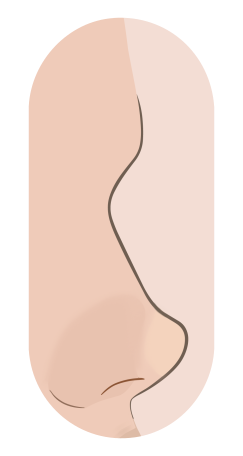
| Bridge | Short and straight |
|---|---|
| Tip | Lifted, nostrils show from the front |
| Nasolabial angle | At or above about 105 degrees |
| Common in | Children, and adults with a short nose |
| Usual width | Often narrow or medium |
| Closest neighbours | Celestial (scooped bridge), Button (rounder tip) |
What is a snub nose?
The bridge is short and mostly straight. The tip rotates upward, so more of the nostrils show from the front than on a straight nose.
It is often described as the opposite of a hawk nose. One hooks down, the other lifts up.
The angle that defines it
Surgeons measure the lift with the nasolabial angle. It is the angle between the bottom of the nose and the upper lip, seen from the side.
Commonly cited ranges in surgical textbooks are about 90 to 95 degrees for men and 95 to 110 degrees for women. A snub nose sits at the top of that range or above it.
You can estimate yours from a side photo. Draw one line along the underside of the nose and one down the upper lip. A wide opening between them means an upturned tip.
The width of your nose is the part a front photo can measure. Our nose shape analyser gives you that in seconds; the profile is for your side photo.
Snub vs celestial vs button
| Shape | Bridge | Tip |
|---|---|---|
| Snub | Short, straight | Lifted |
| Celestial | Scooped in the middle | Lifted |
| Button | Short, soft slope | Small, round, little lift |
The dip in the bridge separates Snub from Celestial. The size and roundness of the tip separate it from Button.
Is a snub nose more common in children?
Yes. Children's noses are short with an upturned tip almost everywhere. The nose grows through the teens, gets longer, and the tip usually rotates down.
Most nose growth is finished by the mid to late teens. A snub nose that is still there at twenty will mostly stay. Age then tends to lower the tip slightly.
Glasses and photos
A short nose gives frames less room. Choose frames that sit a little higher, or with adjustable pads, so the lenses do not rest on the cheeks. Smaller lens heights also help.
In photos, a camera slightly above eye level shows fewer nostrils. A camera held low makes the upturn look stronger.
Questions about the snub nose
Is a snub nose the same as an upturned nose?
Close. Both lift at the tip. Upturned is the general word. Snub adds that the nose is short. If the bridge also dips in the middle, the better name is Celestial.
What is the ideal nasolabial angle?
There is no single ideal. Textbooks often quote about 90 to 95 degrees for men and 95 to 110 for women, but faces that look good fall well outside those ranges.
Can a front photo show a snub nose?
Partly. Visible nostrils hint at an upturned tip, but the angle needs a side view. Our analyser measures width from the front and does not judge the tip angle.
Related nose types
Celestial nose
A celestial nose dips in the middle of the bridge and turns up at the tip. Learn how …
ReadButton nose
A button nose is small with a soft slope and a round, compact tip. Learn the signs, how …
ReadNarrow nose
A narrow nose has a nasal index under 70: much taller than it is wide. Learn what that …
ReadAll twelve profiles: Greek, Roman, Hawk, Nubian, Celestial, Button, Bulbous, Fleshy, Flat, Bumpy, East Asian. Or see every type of nose on one page.
Measure your own nose
One front photo, four measurements, your nasal index band. Free, and the photo is deleted after you see it.
Analyse my nose