Greek nose
A Greek nose has a straight bridge that runs in one clean line from the brow to the tip, with no hump and no dip. You can only judge it from the side, so the test is a profile photo, not a mirror.
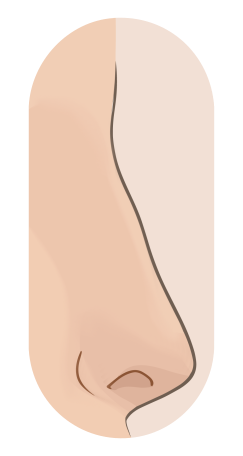
| Bridge | Straight from root to tip, no hump or dip |
|---|---|
| Root | Shallow, so forehead and nose almost meet in one line |
| Tip | Points straight ahead |
| Seen best | From the side |
| Usual width | Any band, often narrow or medium |
| Closest neighbours | Roman (curved bridge), Button (shorter, rounder tip) |
What is a Greek nose?
A Greek nose is a straight nose. The bridge, which anatomists call the dorsum, shows neither a bump nor a scoop. The tip points forward rather than up or down.
The name comes from classical sculpture. Many Greek statues show a face where the forehead flows into the nose with almost no step at the root, the point between the eyes. Artists later called this the Greek profile.
Most living people do not have the statue version. The step at the root is usually deeper, and the bridge is rarely ruler straight. The label is still useful for any nose whose profile reads as one line.
How do I know if I have a Greek nose?
Take a photo from the side, at eye level, against a plain wall. Lay a ruler or the edge of a sheet of paper along the bridge on the screen.
- If the edge touches the whole bridge from the root to just above the tip, the profile is straight.
- If there is a gap in the middle, the nose is scooped, closer to Celestial.
- If the bridge pushes past the edge, there is a hump, closer to Roman or Bumpy.
Then look at the tip. A Greek tip points straight ahead. A tip that lifts clearly is Snub territory, and one that hangs down suggests Hawk.
The width of your nose is the part a front photo can measure. Our nose shape analyser gives you that in seconds; the profile is for your side photo.
Greek nose vs Roman nose
The difference is the line of the bridge. A Greek bridge is straight. A Roman bridge curves outward, so the middle of the nose sits in front of the line between root and tip.
Both can be any width. From the front they can look identical, which is why a front photo cannot separate them. Our analyser reports the width from the front and leaves the profile to you.
Why so many people ask for this shape
A straight bridge is one of the most common goals in cosmetic nose surgery. Surgeons describe it as a smooth dorsum, often with a slight lift at the tip. Lowering a hump to reach a straighter line is one of the procedures they perform most.
That popularity is cultural, not medical. A straight nose breathes no better than a curved one. Breathing depends on the inside of the nose, mainly the septum and the valves near the nostrils.
Glasses and makeup for a Greek nose
A straight bridge holds most frames well, because the nose pads sit evenly on both sides. The number to check is the middle one on the frame, for example 52-18-140. The 18 is the bridge width in millimetres. Match it to a pair that already fits you.
For makeup, there is little to correct. A soft line of highlighter down the centre of the bridge keeps the straight look. Contour along the sides only if the nose looks wide in photos.
Questions about the greek nose
Is a Greek nose rare?
The textbook version with no step at the root is uncommon. A broadly straight bridge is not rare at all. Many people have a nose that reads as straight from a normal distance.
Is a Greek nose the same as a straight nose?
Yes, in everyday use. Strictly, the Greek profile also means a shallow root, so the nose and forehead form an almost continuous line.
Can a Greek nose be wide?
Yes. The name describes the side view only. From the front, a Greek nose can fall in any of the four nasal index bands, from narrow to very broad.
Related nose types
Roman nose
A Roman nose has a bridge that curves outward. Learn the signs, how it differs from a hawk …
ReadButton nose
A button nose is small with a soft slope and a round, compact tip. Learn the signs, how …
ReadNarrow nose
A narrow nose has a nasal index under 70: much taller than it is wide. Learn what that …
ReadAll twelve profiles: Roman, Hawk, Nubian, Snub, Celestial, Button, Bulbous, Fleshy, Flat, Bumpy, East Asian. Or see every type of nose on one page.
Measure your own nose
One front photo, four measurements, your nasal index band. Free, and the photo is deleted after you see it.
Analyse my nose