Roman nose
A Roman nose, also called an aquiline nose, has a bridge that curves outward in a smooth arc, with a tip that points slightly down. The curve is a side-view feature, so you see it best in profile.
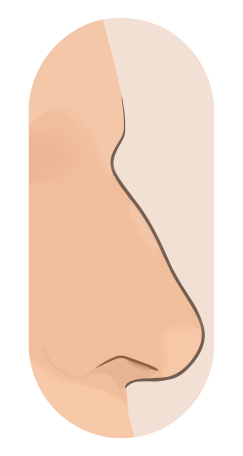
| Bridge | Smooth outward curve, high point in the upper or middle third |
|---|---|
| Tip | Forward or slightly down |
| Length | Often long, projects well |
| Other name | Aquiline, from Latin aquila, eagle |
| Usual width | Any band |
| Closest neighbours | Hawk (stronger hook), Bumpy (local ridge) |
What is a Roman nose?
It is a nose with a convex bridge. Picture a gentle arch from the root between the eyes down to the tip. The highest point of the arch is usually in the upper or middle third.
Aquiline comes from the Latin word for eagle, aquila. The Roman name comes from portraits on Roman coins and busts, where a strong curved profile was common and admired.
Signs of a Roman nose
- From the side, the bridge sits in front of a straight line drawn from the root to the tip.
- The curve is smooth, not a sharp bump.
- The tip points ahead or a little down.
- The nose often looks long and projects well from the face.
If the arch is strong and the tip clearly hooks below the nostrils, Hawk is the better word. If the bridge is mostly straight with one ridge, the nose is closer to Bumpy.
The width of your nose is the part a front photo can measure. Our nose shape analyser gives you that in seconds; the profile is for your side photo.
Roman nose vs hawk nose vs bumpy nose
| Shape | Bridge | Tip |
|---|---|---|
| Roman | Smooth outward curve | Forward or slightly down |
| Hawk | Strong curve, high arch | Pointed, hangs down |
| Bumpy | Straight with a local ridge | Any |
The line between them is soft. Two people can look at the same profile and pick different names. That is normal for labels that came from art rather than measurement.
Does a Roman nose change with age?
The bone and cartilage stop growing in the late teens. After that, the skin and supporting tissue slowly loosen. Over decades the tip can drop a little, which makes the curve of a Roman nose look stronger.
This is gradual and normal. A sudden change in shape, especially after a knock, is different. If breathing also changed, have a doctor look at it.
What suits a Roman nose
Frames with a slightly higher bridge sit on the curve without sliding. Adjustable nose pads help, because they can be bent to meet the slope of the bridge. Very thin, low frames can make the curve stand out more.
In photos, a three quarter angle shows the profile less than a full side view. For makeup, a matte shade just under the highest point of the curve softens it without hiding it.
Questions about the roman nose
Is a Roman nose attractive?
Many people find it striking, and it has been admired in art for over two thousand years. Attractiveness depends far more on how the nose fits the rest of the face than on the shape alone.
What is the difference between aquiline and Roman?
None in everyday use. Both describe a bridge that curves outward. Aquiline is the more formal term.
Can you tell a Roman nose from a front photo?
Not reliably. The curve lies along the line of sight in a front photo. Our analyser therefore reports the width of your nose from the front and leaves the profile to a side photo.
Related nose types
Hawk nose
A hawk nose has a high curved bridge and a tip that hooks down. See how it differs …
ReadBumpy nose
A bumpy nose has a ridge or hump partway down the bridge. Learn if it is genetic or …
ReadGreek nose
What a Greek nose is, how to tell if you have one, how it differs from a Roman …
ReadAll twelve profiles: Greek, Hawk, Nubian, Snub, Celestial, Button, Bulbous, Fleshy, Flat, Bumpy, East Asian. Or see every type of nose on one page.
Measure your own nose
One front photo, four measurements, your nasal index band. Free, and the photo is deleted after you see it.
Analyse my nose